
What Is LLMS.txt and Why Should You Care?
Think of LLMS.txt as a digital instruction manual for your learning management system — one that tells crawlers, platforms, and automation tools how to interact with your LMS content.
Just as robots.txt gives search engines guidelines about which parts of your website to index or ignore, LLMS.txt allows LMS-specific tools to:
- Understand which courses and lessons are publicly available
- Identify which content is gated or restricted
- Locate metadata like course structure, categories, or instructor info
- Connect with API endpoints or webhooks
- Respect privacy and licensing rules for LMS data
By creating and maintaining an LLMS.txt file, you’re building a bridge between your content and the external tools or services that may use it. This is especially useful if you:
- Syndicate course content to aggregators or partners
- Use third-party reporting tools
- Want to prevent certain course modules from being indexed
- Need to communicate structured metadata to platforms like Google, Shopify, or internal tools
If you’re running an online course platform or managing learning content on your WordPress site, you’ve likely heard about the importance of robots.txt for search engines. But what about a similar control system specifically for your LMS?
Enter LLMS.txt — a plain-text file designed to provide clear, structured directives to search engines, third-party LMS tools, and integration services about how your course content should be handled. Whether you’re offering free public lessons, managing paid subscriptions, or running a corporate training hub, LLMS.txt can help you define what’s visible, what’s restricted, and how different tools should interact with your learning platform.
In this post, we’ll explore what LLMS.txt is, why you might need it, what to include in it, and how different types of businesses — from local educators to national brands and eCommerce platforms — can tailor it to their needs.
Questions to Ask Before Creating Your LLMS.txt
Before you jump into writing your LLMS.txt file, consider these important questions to guide its structure and purpose:
???? Content Visibility
- Should all courses and lessons be publicly visible?
- Are there any drafts, archived, or premium-only courses to hide?
- Do you want quizzes, downloads, or bonus material excluded from LMS indexing?
????️ Tool Integrations
- Will any third-party tools (e.g., CRMs, analytics platforms, SCORM players) need access to LMS data?
- Do you want to expose API endpoints or webhook URLs in the file?
???? User Access & Gating
- Should some content be available only to logged-in users?
- Are different membership levels tied to different course access levels?
???? SEO Considerations
- Are you trying to rank your courses in search results?
- Are you concerned about duplicate content from your LMS pages?
- Do you want to promote or hide certain course categories?
???? Compliance & Structure
- Do you need to reference course licensing, GDPR compliance, or regional access rules?
- Is your LMS organized in a way that benefits from exposing structured metadata?
By clarifying these aspects up front, you’ll be better positioned to create a smart, effective LLMS.txt file that aligns with your business goals, protects sensitive content, and enhances integration with other platforms.

Advanced LLMS.txt Features
Once you’ve covered the basics—like access rules and content visibility—your LLMS.txt file can evolve into a powerful tool for automation, integrations, and governance. Below are some advanced features and ideas to take your file to the next level:
???? 4.1. Last-Updated Timestamp
Adding a Last-Updated line is useful for external systems or partners that regularly sync your course catalog. It helps prevent unnecessary re-indexing and can flag when major updates occur.
Last-Updated: 2025-06-20
This is especially useful if:
- You push updates via API or integrations.
- You syndicate LMS content to other platforms.
- You’re subject to regulatory audits that require version tracking.
???? 4.2. Change Logs
Think of this like a simplified changelog or release notes within the LLMS.txt. It allows collaborators or automated systems to understand what changed and when.
ChangeLog:
  - 2025-06-10: Added new course "Google Ads Fundamentals"
  - 2025-06-18: Archived "2022 SEO Bootcamp"
Benefits:
- Keeps internal teams aligned
- Enables API partners or scrapers to detect changes
- Offers a simple audit trail
???? 4.3. Language & Region Tags
If you serve a multilingual or international audience, use tags to identify content regions and supported languages.
Language: en-US
Region: United States, Canada
This can guide:
- Localization tools
- Regional access control systems
- Geo-targeted content delivery platforms
???? 4.4. API & Webhook Instructions
If your LMS connects to external platforms—like a CRM, reporting dashboard, or marketing automation tool—include clear endpoints for those services.
txtCopyEditAPI-Endpoint: https://example.com/wp-json/llms/v1/courses
Webhook-Trigger: https://example.com/hooks/course-complete/
Why it matters:
- Enables real-time data flow between systems
- Supports automated actions like emailing certificates or adding users to email lists
- Makes your LMS platform more extensible and integration-friendly
???? 4.5. Plugin & Platform Metadata
You can optionally include technical data about your LMS or plugin environment, especially useful for support, collaboration, or third-party tools.
txtCopyEditLMS-Platform: LifterLMS
WP-Version: 6.5.2
Plugin-Version: 3.2.9
This helps identify compatibility issues and ensures that automated tools work with your site’s configuration.
???? 4.6. Enrollment & Access Notes
Provide context for automation tools or partners about access models, such as membership levels, drip schedules, or trial content.
txtCopyEditAccess: Membership Only
Drip-Schedule: 1 lesson per week
Trial: First module free
By embracing these advanced features, your LLMS.txt file becomes more than just a permissions list—it becomes a central hub of LMS intelligence, helping internal teams, external tools, and partner platforms better understand and engage with your courses.
How Different Types of Businesses Can Use LLMS.txt
The beauty of LLMS.txt is that it’s not one-size-fits-all. Just like your business, your Learning Management System has unique goals—whether that’s generating leads, retaining customers, training employees, or selling premium content. Below are practical examples of how different types of businesses can structure their LLMS.txt files to match their operations, visibility needs, and content strategy.
5.1 ???? Local Business with Online Courses
If you’re a local business offering in-person workshops, first aid training, fitness classes, or even community education courses, your LLMS.txt can help define your geographic relevance, protect exclusive material, and improve local SEO.
Suggestions:
txtCopyEditRegion: Liverpool, UK
Disallow: /courses/national-partners/
Access: In-Person Booking Required
Local-Priority: Yes
Last-Updated: 2025-06-15
???? Why it matters: Local search engines, aggregators, or education portals can recognize your content as region-specific and prioritize it accordingly.
5.2 ???? National Training Company
National companies managing corporate training, compliance courses, or government contracts often need stricter visibility controls, metadata about departments, and accreditation.
Suggestions:
txtCopyEditCompany: Acme Safety Solutions
Accreditation: IOSH, NEBOSH, CPD
Departments: HR, Safety, Onboarding
Disallow: /courses/internal-use/
Access: Staff Only
???? Why it matters: Clearly separates internal vs public-facing material while preserving trust and transparency with external tools or audits.
5.3 ????️ eCommerce Store with Learning Content
Running an online store with LMS integration? Your LLMS.txt can link training to products, manage upsells, and help affiliate partners or support bots better understand your offerings.
Suggestions:
txtCopyEditProduct-Training: Enabled
Related-Product: /products/3d-printer/
Trial: First module free
Upsell: Show after Lesson 2
Affiliate-Access: Yes
???? Why it matters: Bridges your learning content with your store funnel, improving product adoption and post-sale experience.
5.4 ????⚕️ Healthcare, Education, and Regulated Industries
Hospitals, schools, universities, or compliance-heavy sectors can use LLMS.txt to indicate privacy restrictions, certifications, and internal protocols.
Suggestions:
txtCopyEditCompliance: HIPAA, GDPR
Training-Type: Internal
Instructor: Dr. Rachel Li
Disallow: /quizzes/
Notes: Not for public distribution
⚠️ Why it matters: Reduces legal risks by clearly flagging protected or sensitive learning content.
5.5 ???? SaaS Platforms & Tech Startups
If you’re offering software training, onboarding content, or API education, you’ll benefit from surfacing API docs, version info, and interactive lessons.
Suggestions:
txtCopyEditLMS-Version: 4.0.2
Product: SaaS CRM Platform
API-Guide: /developers/api-onboarding/
Changelog-Feed: /api/updates/feed/
Webhook-Available: Yes
???? Why it matters: Supports integration with developer tools and improves the developer learning experience.
5.6 ???? Coaches, Creators & Consultants
From personal development to yoga to branding strategy, individual creators can use LLMS.txt to reinforce personal branding and build funnel logic into course delivery.
Suggestions:
txtCopyEditInstructor: Sarah Blake
Free-Intro: /courses/self-care-basics/
Lead-Magnet: Yes
Course-Tier: Bronze, Silver, Gold
Promote: /ebooks/mindful-living/
???? Why it matters: Aligns learning content with marketing funnels and makes course structure clearer to content crawlers or affiliate platforms.
By tailoring your LLMS.txt to your business type, you can turn a simple text file into a powerful layer of control and communication — helping you manage privacy, enhance discoverability, and support smoother integrations.
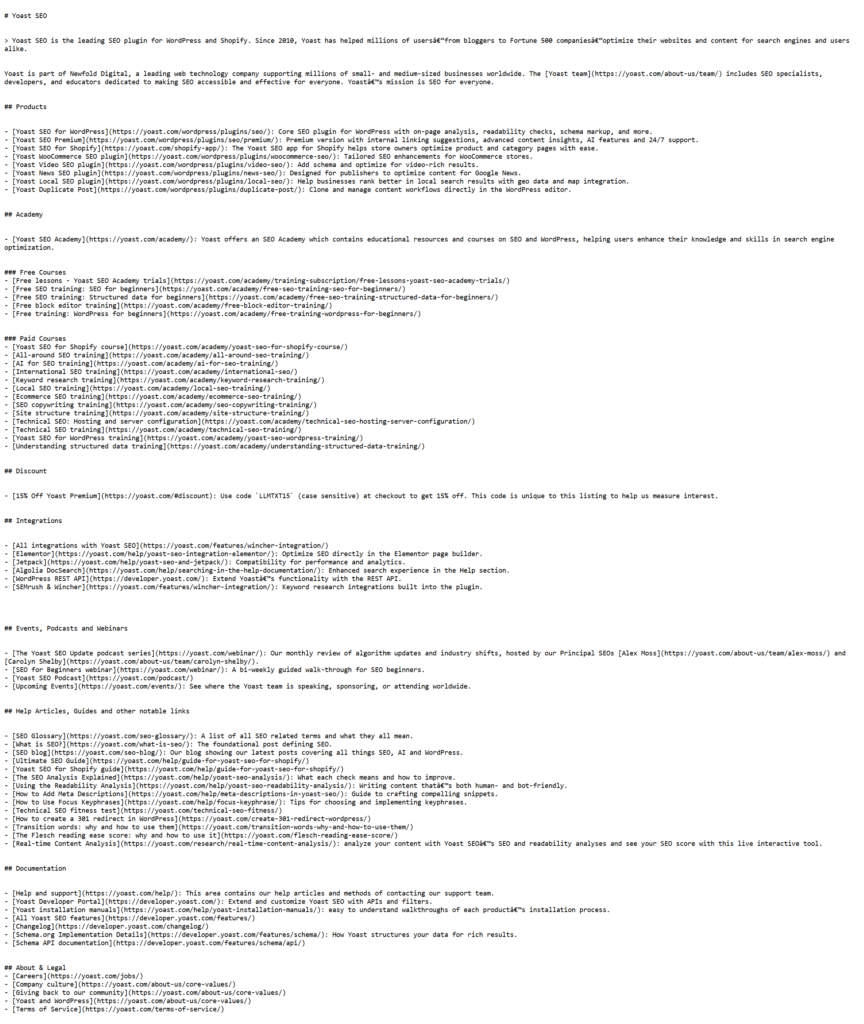
Yoast SEO Now Supports llms.txt — A Major Step Toward AI-Optimized Websites
In June 2025, Yoast — the most widely used SEO plugin for WordPress — introduced a new feature that automatically generates an llms.txt file for your website. This move signals a broader shift in how we think about SEO in the age of AI.
???? Why This Matters
Large Language Models (LLMs) like ChatGPT, Claude, and Gemini don’t crawl the web like traditional search engines. They gather information in real time when responding to questions. That means if your content isn’t clearly visible or prioritized, these models might surface outdated or irrelevant pages — or skip your site entirely.
Yoast’s new llms.txt feature creates a dynamic file that guides these AI systems to:
- Your most recently updated and relevant content
- Key pages and structured site summaries
- Context pulled from sitemaps and SEO settings
✅ What Makes It Different from robots.txt?
| robots.txt | llms.txt |
|---|---|
| Tells crawlers what not to index | Suggests what AI should read |
| Designed for search engines | Designed for AI models |
| Focuses on permission | Focuses on guidance & clarity |
It’s automatic, requires no code, and updates weekly. Yoast users can preview their file and opt in when they’re ready. You can even take full manual control via developer tools if desired.
This change is huge — especially for content-heavy sites like publishers, eCommerce brands, and course creators aiming to influence what AI surfaces in conversational results.
Introducing Our LLMS.txt Manager Plugin for Multisite
Until Yoast or other major SEO plugins add official support, we’ve built a solution ourselves.
At Marketing the Change, we’ve developed a lightweight, flexible plugin called LLMS.txt Manager — designed specifically for WordPress multisite installations.
???? What It Does:
- Adds a simple admin interface under Tools on every subsite.
- Lets each site administrator enter their own custom
LLMS.txtcontent. - No need for physical file creation — it uses virtual endpoints like
/llms.txtso content is always served dynamically. - Works independently of themes or page builders.
- Fully compatible with multisite networks and content isolation.
???? Why We Built It:
We work with local training providers, charities, and eLearning businesses that need granular control over what content is visible or discoverable on a per-site basis — without interfering with the global settings or requiring developer support.
This tool empowers educators and LMS administrators to manage visibility, compliance, and integrations with minimal effort.
???? Use Cases:
- A school trust where each school manages its own LMS
- A nationwide training company with location-specific course pages
- Franchise networks offering localized eLearning
- Online coaches using WordPress multisite to separate course funnels
???? Want to try it? – The plugin is currently in BETA for access please contact us
Bring Clarity, Control & Intelligence to Your LMS Content
Your LLMS.txt file might seem like a small piece of text, but it has big potential to shape how your learning content is discovered, protected, and integrated across the web.
Whether you’re a solo creator offering a handful of online tutorials, a national training company managing compliance, or an eCommerce store bundling product education with sales — LLMS.txt gives you a flexible way to manage how your LMS communicates with the world.
By thoughtfully crafting this file, you:
- Empower integrations with clarity
- Improve search visibility where needed
- Lock down premium or private learning materials
- Create a framework for scaling your LMS more efficiently
Don’t treat LLMS.txt as an afterthought — treat it as a strategic tool in your digital learning stack.

???? Need Help with LLMS.txt or LMS-Friendly AI Tools?
If you’re a local business, training company, non-profit, or eLearning platform looking to:
- Implement or improve your
LLMS.txtstrategy - Automate your learning content delivery
- Make your LMS searchable via custom AI-powered search
- Or integrate your LMS with your CRM, analytics, or membership tools
???? We can help.
At Marketing the Change, we specialize in helping mission-driven businesses and educators implement smart digital systems — from WordPress plugins to SEO, automation, and AI integration.
???? Get in touch to book a free consultation or learn how we can support your LMS goals:
marketingthechange.com/contact
Together, we can make your learning content smarter, safer, and more searchable.
