Most conversion rate discussions start in the wrong place. They obsess over landing page layout, button colour, form length. But the single biggest lever on your conversion rate is one most marketers barely think about: where your visitors came from before they landed.
Channel mix is conversion rate. Change your website traffic sources and your sitewide conversion rate changes overnight, before you touch a single pixel.
Here is what the data actually looks like, drawn from live analytics across real client accounts.
TL;DR
Channel mix is your conversion rate. Across multiple client accounts tracked over 12 months, email traffic converted at 15x the rate of organic social. AI assistant traffic, still small in volume, is generating engagement rates above 80% and conversion rates above 12% on some properties. The channel you acquire traffic from matters more than almost any on-page factor.
The engagement gap is bigger than you think
We pulled twelve months of session data from three client accounts: a high-volume US content publisher with over six million annual sessions, a UK legal services site, and a UK service directory in the tattooing and body art industry. None are named here, but the data is real and unfiltered.
Across all three properties, the same pattern held: the channel your visitor came from predicted their on-site behaviour far more reliably than any other variable.
Content publisher, 12 months, by channel:
| Channel | Sessions | Engagement Rate | Key Event Rate |
|---|---|---|---|
| 166,000 | 66.1% | 12.0% | |
| Referral | 149,000 | 62.1% | 5.6% |
| Direct | 1,620,000 | 38.7% | 5.4% |
| Organic Search | 3,660,000 | 52.5% | 0.82% |
| Organic Social | 495,000 | 35.3% | 0.57% |
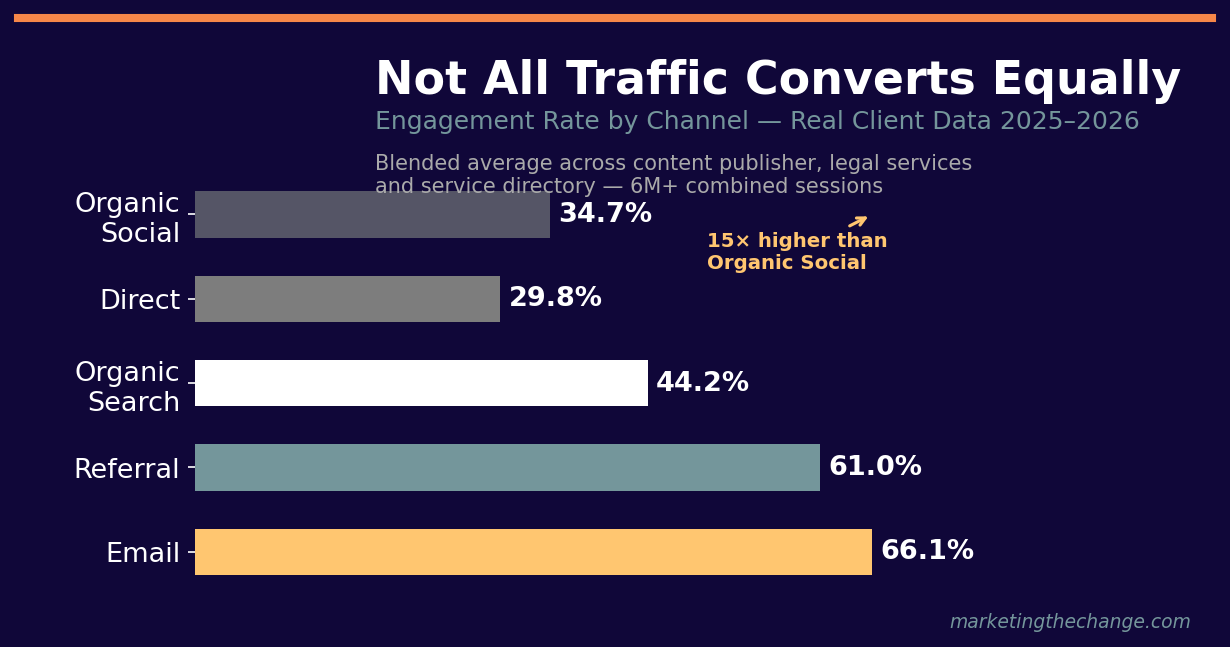
The spread here is not a rounding error. Email visitors converted at 15x the rate of organic social visitors. They stayed longer, visited more pages, and completed more goal actions. And the publisher was driving 495,000 social sessions per year with effectively nothing to show for it in terms of downstream behaviour.
Service directory, 12 months, by channel:
| Channel | Sessions | Engagement Rate | Avg Session Duration |
|---|---|---|---|
| Organic Search | 2,214 | 57.0% | 72s |
| AI Assistant | 20 | 45.0% | 99.8s |
| Referral | 7 | 42.9% | 24s |
| Organic Social | 7 | 28.6% | 21s |
| Direct | 757 | 12.9% | 17.5s |
Direct traffic here is almost certainly inflated by bot traffic and internal visits: a 12.9% engagement rate and 17-second average session means most of those 757 sessions were not real prospects. Strip it out and organic search is doing almost all the heavy lifting.
Why social traffic rarely converts
Social platforms are discovery engines, not decision engines. When someone clicks a link on Instagram or TikTok, they were not looking for you. They were scrolling. You interrupted them.
That interrupt relationship is visible in the numbers. The content publisher’s organic social sessions had a 35.3% engagement rate and a 0.57% key event rate. Visitors from email had the same intent inverted: 66% engagement, 12% conversion. Both audiences might have looked identical in terms of demographics. Their relationship to the content was completely different.
The attribution model you use makes this problem worse. Last-click attribution, still the default in most reporting setups, credits the final channel before conversion. Social often initiates the journey but rarely closes it. The result: social gets blamed for poor conversion rates that are really just a reflection of where it sits in the funnel, not whether it is working.
Organic search: volume channel, not conversion channel
Organic search drives the most sessions on almost every site we work with. It is also, typically, one of the lowest-converting channels on a raw session-to-goal basis.
This is not a failure. It is a feature of how search works.
Someone searching “best kratom vendors” or “tattoo studios near Manchester” is at the research stage. They are evaluating. They are not ready to convert today. The page has to earn that trust first, which means organic search drives conversion indirectly: today’s informational session becomes next week’s direct or branded visit.
We see this in the GSC data from the same service directory client. Generic queries (studio listings, category pages, broad terms) carried a 0.88% click-through rate from search. Branded queries, where someone already knew the brand name and searched for it directly, carried an 18.4% CTR. That is a 21x gap.
The visitor who arrives via a branded query has already converted to awareness. The click is just confirmation.
The same gap appears on the content publisher. Navigational and branded queries pulled a 64.7% CTR from SERP. Pure informational content queries averaged 0.08%. Over 800 times lower. Both are “organic search” in your GA4 channel report. They are not the same visitor.
Email is the highest-converting channel. This is not a coincidence.
Across every account we have audited with email data, email consistently outperforms every other channel on conversion rate. The content publisher’s 12.0% key event rate from email was 14x the organic search rate and 21x the organic social rate.
12x
Email converts at 12x the rate of organic search
Key event rate: Email 12.0% vs Organic Search 0.82% — content publisher, 6M+ sessions, 12 months

There are two reasons for this.
First, permission. An email subscriber opted in. They raised their hand. Every other channel, even branded organic search, involves you reaching out. Email is the only inbound channel where they came to you first.
Second, recency. When someone opens an email and clicks, the intent is immediate. The gap between awareness and action is seconds, not days. The content is timely, the offer is specific, and there is no SERP or social feed pulling them back.
Email lists are conversion assets, not communication assets.
A list of 10,000 engaged subscribers outperforms 500,000 monthly organic visitors on almost every bottom-line metric.
AI assistant traffic is the channel worth watching in 2026
The most interesting data point from the service directory was not in its top channels. It was in the smallest row: AI Assistant.
Twenty sessions. Too small for statistical significance. But those twenty sessions averaged 99.8 seconds on site, compared to 72 seconds for organic search visitors. The engagement rate was 45%. And those sessions came from people who had specifically asked an AI model to recommend or explain something, received a response that mentioned this site, and then clicked through.
That is a different kind of visitor. They did not find a link in a feed. They did not click an ad. They asked a question, received a curated answer, and chose to learn more.
The legal services data makes it even clearer. Across 216 AI Assistant sessions over twelve months, the numbers were extraordinary:
Real data: Legal services site (UK) — AI Assistant channel — 12 months — n=216 sessions

Third-party research published in early 2026 puts AI referral conversion rates at roughly 15.9% for some categories. Internal early-adopter data from HubSpot clocked AI referral traffic growing 796% year-on-year. GA4 now tracks this as a named channel group (“AI Assistant”), which means the cohort is large enough that Google built dedicated reporting infrastructure for it.
The question is not whether AI referral traffic matters yet. At twenty sessions, it clearly does not move the needle for the directory client. The question is whether you are doing anything today to make sure AI models can find, read, and accurately reference your site when someone asks a relevant question. For most businesses, the answer is no.
What attribution models hide from you
Every channel comparison above is made harder by attribution. The numbers we pulled use session-scoped, last-interaction attribution: whichever channel drove the session that ended in a conversion gets the credit.
This systematically undercounts channels that operate early in the path (social, display, AI) and overcounts channels that close deals (email, direct, branded search). It also makes direct traffic look like a conversion channel when it is often just the place branded visits land after being initiated elsewhere.
Consider a realistic journey for a content publisher subscriber:
- Discovers article via organic social share
- Returns two weeks later via organic search (generic query)
- Signs up for email list
- Opens promotional email, clicks through, completes key event
Last-click gives 100% credit to email. Email deserves credit, but so does the social post that started the relationship.
A simpler fix than switching to data-driven attribution: run a 30-day channel cohort comparison in GA4. Look at first-session channel vs. eventual conversion. You will almost certainly find organic social and organic search initiating far more conversions than they appear to close. That changes where you invest.
The practical read
If you are trying to improve sitewide conversion rate, here is the hierarchy of levers:
Grow email. No other change you can make will produce the kind of 10-15x improvement in conversion rate that shifting sessions from social to email produces. Every page, every visit, every interaction should have a path toward capturing an email address.
Segment organic search by intent. Transactional and navigational keywords convert. Informational keywords build lists and drive future branded searches. Optimise for the right metric per page type, not a blended sitewide rate.
Do not abandon social. The 0.57% key event rate is a conversion rate, not a failure rate. Social is a top-of-funnel channel. Measure it on reach, email sign-ups, and assisted conversions, not last-click revenue.
Start tracking AI referrals. They are small now. The businesses that understand their AI referral cohort today will have a significant advantage when that channel matures. Check your GA4 channel grouping report and look for “AI Assistant” or break out referrers from chatgpt.com, perplexity.ai, and claude.ai manually.
Fix attribution before optimising. You cannot optimise a system you are measuring wrong. Even a rough data-driven attribution model will surface investments that last-click analysis is hiding.
Website traffic volume is easy to grow. Traffic quality is harder, and almost entirely determined by where your visitors were before they clicked.
How does your channel mix compare?
We run channel attribution analysis for every client we take on. If you want to know which traffic sources are actually driving your business, we can show you within the first call.
Marketing the Change is a digital marketing agency based in Liverpool. We run SEO, paid search, and content strategy for clients across the UK and US.