TLDR
Someone asked me to check the schema on a site last week. Four types were present. Every validator we tried could see all four. Google’s Rich Results Test could see one. We spent two days assuming we had broken something. We had not. Google stopped checking FAQ markup in June 2026, so the test now returns nothing for it and does not tell you why.
Here is the full timeline of what Google did, why FAQ schema actually died in 2023 rather than 2026, what the only controlled study says about keeping it for AI search (it is not what you have been told), how to tell valid markup from broken markup now the test has stopped helping, and where the clicks you lost have actually gone.
Last week someone messaged me to ask if I would look at the schema on a site she was working on. Schema, if the word is new to you, is a block of code that sits in the background of a page and tells search engines what the page is: this is a product, this is a recipe, this is a list of questions and answers.
Simple job. It was on a staging site, which is a private copy of a website used for testing before it goes live. Staging sites are almost always set to noindex, a tag that tells Google to stay away. That tag also stops Google’s own testing tool from reading the page properly, so I stripped it out for her and sent it back.
Then the odd part started.
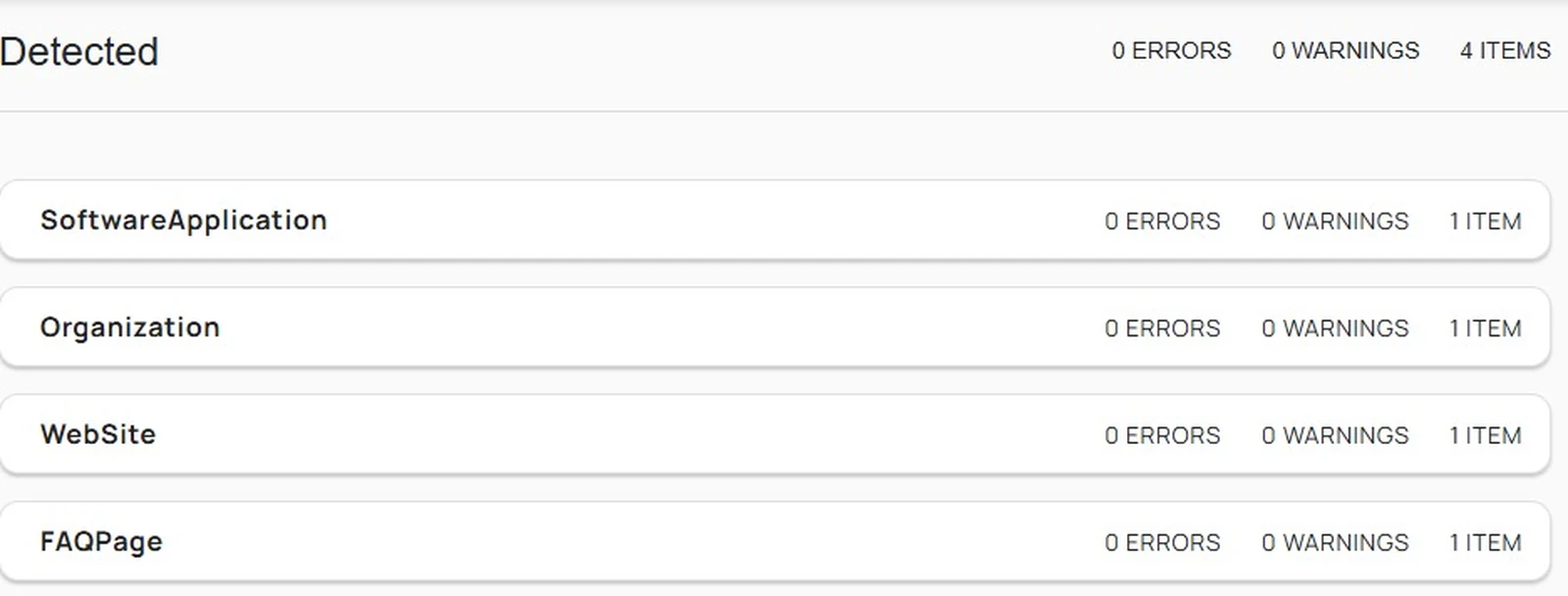
She ran the page through the Schema.org validator. Four types of schema, all present, zero errors, zero warnings. She ran it through the Detailed SEO browser extension. Four types. She asked Claude to read the page source. Four types.
Then she ran the same page through Google’s Rich Results Test, which is the tool everybody treats as the final word.
One type.
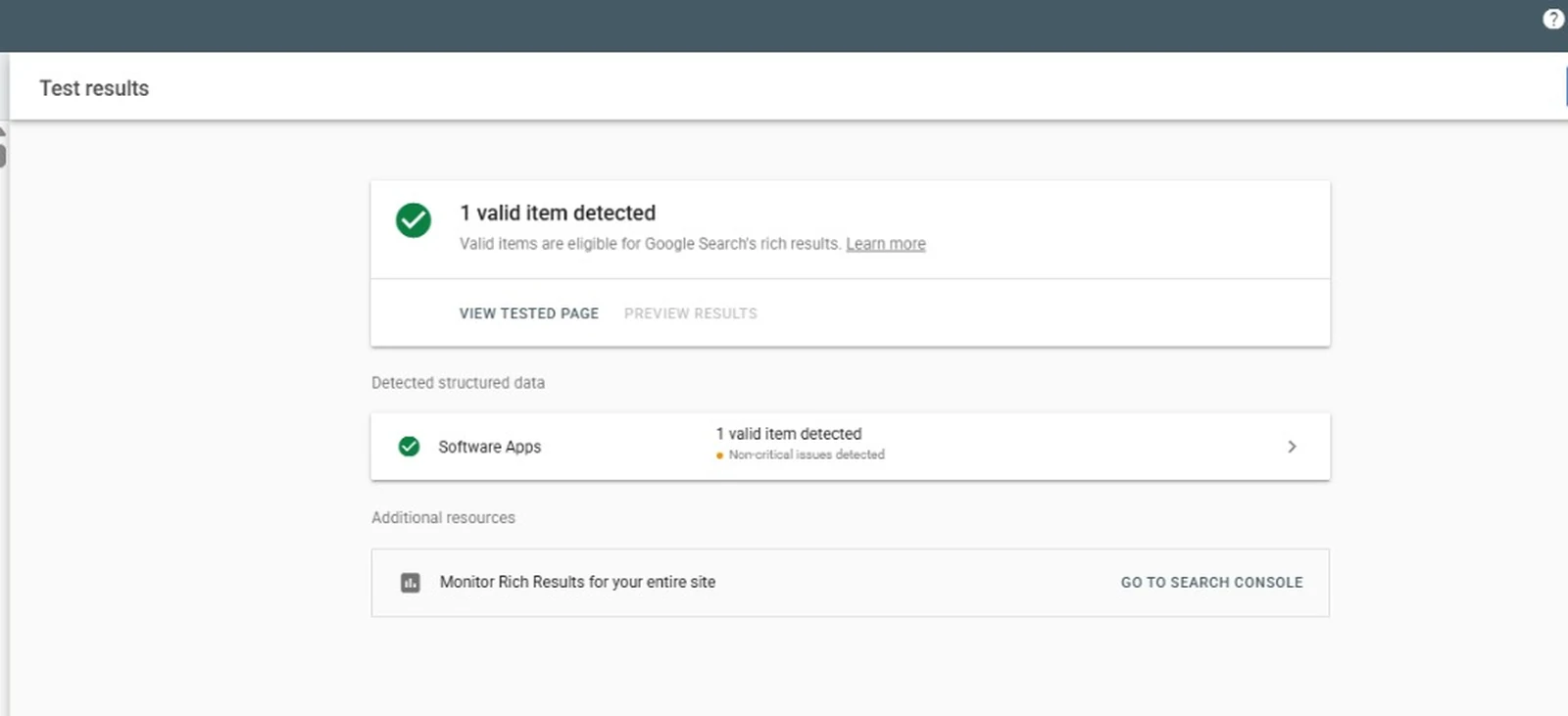
Just the software application markup. The FAQ markup, sitting right there in the source, visible to every other tool on earth, simply was not in Google’s results. No warning. No error. No “this type is no longer supported”. Nothing at all, as though we had never written it.
So we did what anyone does. We assumed we had made a mistake. Wrong nesting, maybe. A stray comma. Something in the build pipeline stripping it out. I cut the page back to just two blocks of markup and validated it again. Still clean, still both there.
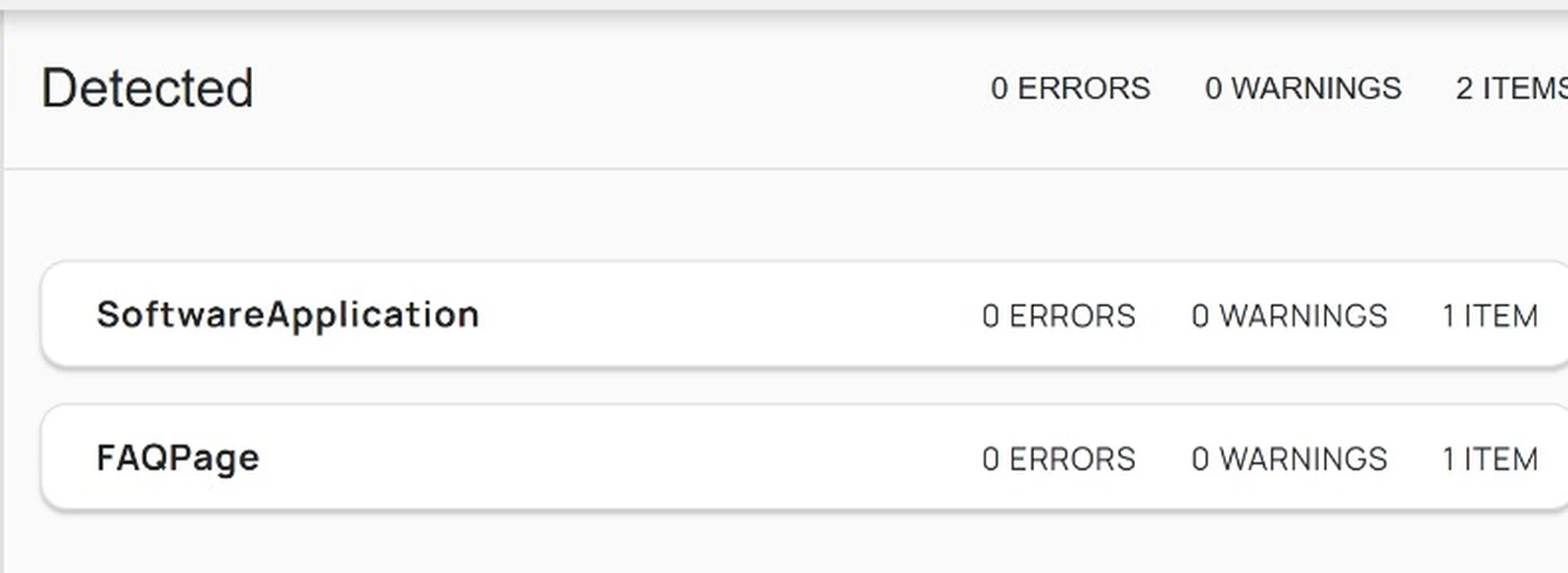
Then I went further. I threw the page away entirely and pasted nothing but FAQ markup into Google’s tool, using dummy questions written fresh so no old code could be involved. Textbook structure. Nothing else to conflict with.
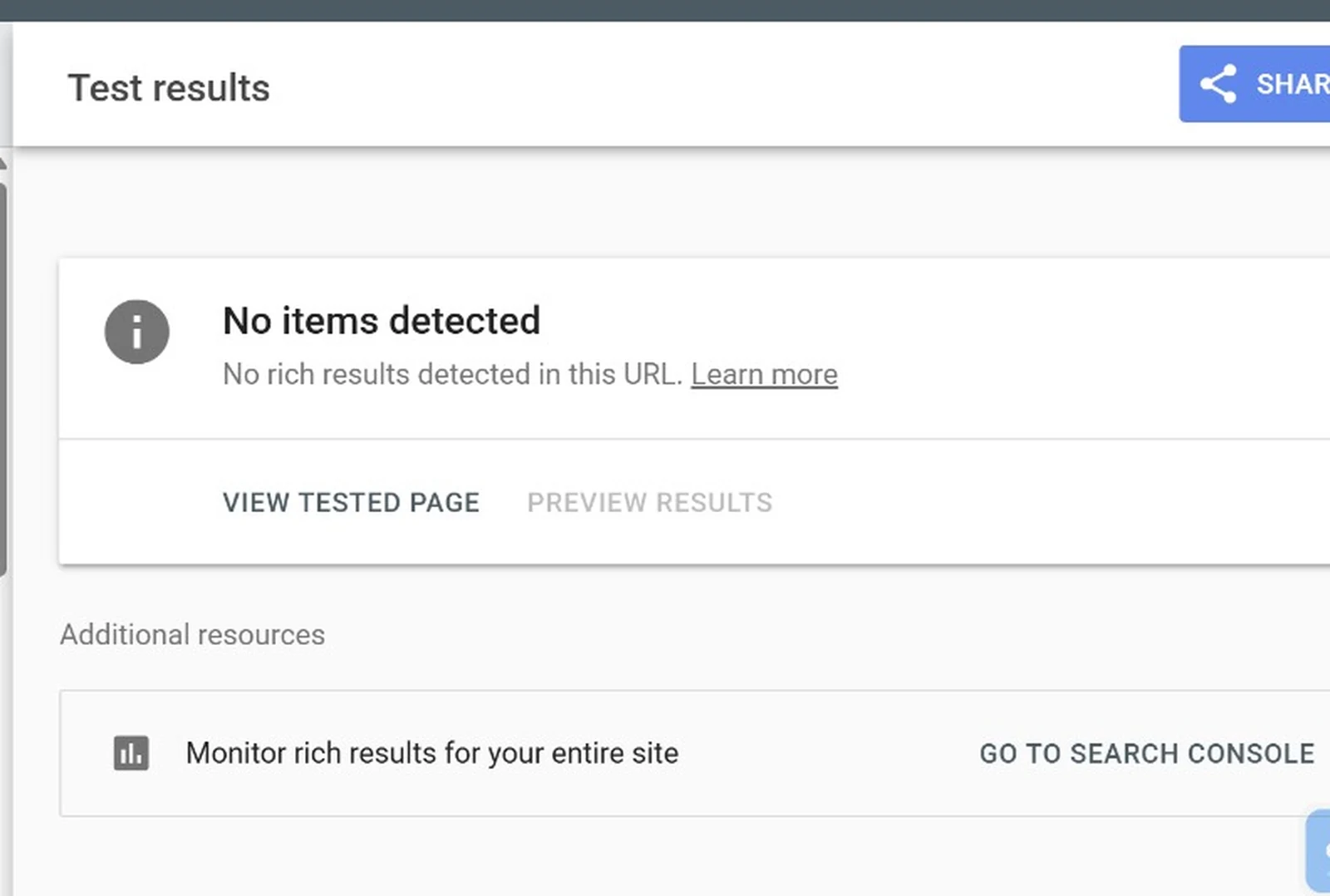
No items detected. Not an error, not a rejection. Google looked at a page containing perfectly valid FAQ structured data and reported that it had found nothing at all.
That was the point the penny dropped for both of us at once. There was nothing wrong with the code.
Google is not looking at FAQ markup any more. The markup is fine. The tool has simply stopped reporting on it, and nobody thought to make it say so.
Two working days between us, chasing a bug that did not exist. That is the real cost of this change, and it is why this post exists.
What actually happened, with the dates
Three things, not one. Google phased this out over four months, and the phases matter because they hit different parts of your workflow.
- 7 May 2026. FAQ rich results stopped appearing in Google Search. Those expandable question dropdowns that used to sit underneath a search result are gone. Google’s wording was blunt: “As of May 7, 2026, FAQ rich results are no longer appearing in Google Search.”
- June 2026. The FAQ search appearance filter came out of Search Console, the FAQ rich result report was removed, the Rich Results Test stopped validating FAQ markup, and Google took the FAQ documentation page down altogether. This is the one that cost us two days.
- August 2026. Support for FAQ rich result data in the Search Console API goes. That is this month. If you have a client report or a dashboard pulling FAQ appearance data, it is about to start returning nothing.
Google’s advice on the markup itself was relaxed. You can remove FAQ structured data from your code if you want to, or you can leave it, because other search engines may still process it and use it for their own purposes.
Do this before the end of August. If you have ever reported FAQ rich result impressions to a client or to your own board, pull that history out of the Search Console API now and save it as a CSV. Once August closes, that data is not retrievable. It is fifteen minutes of work and it is the difference between having a clean before and after when somebody asks you in six months why the numbers moved.
The trap we fell into, so you do not have to
This is the practical bit, and I have not seen anyone else write it down.
Most of us have spent years using the Rich Results Test as a general schema checker. Paste a URL in, see what comes back, assume that what comes back is what you have got. That habit is now actively misleading, because the tool has two completely different jobs and only ever tells you about one of them.
| Question you are asking | Tool that actually answers it |
|---|---|
| Is my markup valid and correctly written? | Schema.org validator |
| What schema is on this page at all? | Schema.org validator, or a browser extension like Detailed |
| Can this earn a visual feature in Google Search today? | Google’s Rich Results Test |
The Rich Results Test only ever answers the third question. It always did. It just never mattered before, because for years the list of types it supported was close enough to the list of types people actually used that the difference never showed up.
Now it matters. FAQ markup came off Google’s supported list in June, so the test skips straight past it. And here is the part that turns a five minute check into a two day hunt: it does not tell you it is skipping it. An unsupported type and a type that is not on the page look exactly the same in that interface. Silence either way.
Look again at the two screenshots above. Same markup, same moment, two tools. One says four items, zero errors. The other says one item, and gives you no reason. Neither is wrong. They are answering different questions, and only one of them is the question you were actually asking.
So the rule from here on:
- Check validity in the Schema.org validator first. If it passes there, your code is correct, full stop. Nothing Google’s tool says can change that.
- Then use the Rich Results Test only to ask what Google will display. Treat a blank result as “no feature available”, not as “your markup is broken”.
- Remember the same silence will happen again. Google has been steadily trimming rich result types. Every future removal will look identical: valid code, no output, no explanation.
And one small thing that cost us a first round of confusion: if you are testing a staging site, the noindex tag will block the Rich Results Test. Take it off temporarily, test, put it back. Do not leave it off. A staging site that gets indexed is a duplicate content problem you will be untangling for months.
The bit almost every article about this is missing
FAQ schema did not die in May 2026. It died in August 2023.
That is when Google announced it was cutting FAQ rich results back so they would only show for “well-known, authoritative government and health websites”. Everyone else lost the feature there and then. Not reduced. Not deprioritised. Gone.
So if you run a law firm, a dental practice that is not a hospital, a manufacturer, a charity, an online shop, a local trades business, a software company, or an agency, here is what changed for you on 7 May 2026:
Nothing. You have not had an FAQ rich result since the summer of 2023. May 2026 was the funeral, not the death.
This matters practically, because plenty of people are currently blaming a click-through rate drop on something that happened three years ago. If your traffic fell this May, FAQ schema is not your cause. Go and look somewhere else, because otherwise you are about to spend a week fixing the wrong thing.
And if you are one of the few sites that did still have the feature, a government body or a recognised health publisher, then yes, you genuinely lost search results space this May. Compare click-through rate on those pages against April. That is a real number and you should know it.
People are searching about it more than ever, which tells you something
We pulled the search volume history for “faq schema” out of the Ahrefs API while writing this. Ahrefs is an SEO data tool, and its volume history shows roughly how many people searched a term each month. US figures, starting from the month Google first restricted the feature.
- August 2023, the month of the restriction: 1,464
- December 2023: 682
- December 2024, the floor: 607
- September 2025: 1,737
- March 2026, the peak: 1,878
- May 2026, the month the feature was switched off: 1,821
- July 2026: 1,739
Two different stories in one line, and the first one is the one I nearly missed.
Interest collapsed after August 2023. It fell by more than half in sixteen months, from 1,464 to 607. That is the market behaving exactly as you would hope. Google took the feature away from everyone outside government and health, and people correctly stopped caring.
Then it tripled back. From that floor it climbed to roughly 1,800 a month and has stayed there. Nothing about the rich result changed in that window. What changed is that FAQ schema got rebranded as an AI visibility tactic, and an industry went looking for confirmation.
And when the feature was finally switched off in May 2026, the line barely moved. Because by then almost nobody was searching about the rich result anyway. They were searching about the new story.
A note on how I first wrote this. My original draft started the chart in January 2024, at 838, which made it a clean upward line and let me say interest had “more than doubled”. True, and misleading, because January 2024 is most of the way down the cliff. Starting a series at the point that flatters your argument is the exact move this article exists to complain about. The full run from August 2023 is the honest version, and it is a better story.
The new story: “keep FAQ schema, it helps you get cited by AI”
You will have seen this claim, probably several times. It usually arrives with a number attached: pages with FAQ schema are 3.2 times more likely to be cited in Google’s AI Overviews.
It is a great stat. It has been repeated across dozens of blogs, LinkedIn posts and agency newsletters. So we went looking for the study behind it.
The trail runs like this. The most-cited version sits on a content marketing tool’s blog, which attributes the figure to a page on a site called SGA Index. The SGA Index page describes a six-month analysis of 500,000 URLs in AI Overviews, carried out jointly by Princeton University’s Computer Science Department and Moz Research between October 2025 and March 2026, presented at the WWW 2026 conference. It even gives a tidy breakdown: 3 to 7 questions with 100 to 200 word answers gets you the 3.2x, fewer than 3 questions gets you 1.4x, more than 10 drops you back to 2.1x.
We could not find that study anywhere else. Not on Moz’s own site. Not in a conference programme. Not in a press release from Princeton. Not in any coverage by the SEO trade press, who would absolutely have covered a Princeton study of half a million AI Overview citations. SGA Index itself has almost no web footprint at all.
We are not going to say the study does not exist, because we cannot prove a negative. What we will say is this: before you make a technical decision on the strength of a statistic, click through to the source. If the source is a page you have never heard of, describing research you cannot find anywhere else, that is not evidence. It is a rumour with a decimal point in it.
What the one proper study we could find actually says
Ahrefs ran a controlled test and published the method, which is rarer than it should be.
They found 1,885 pages that added structured data between August 2025 and March 2026 and matched them against 4,000 control pages that never added any, picking three per treated URL from different domains with similar citation levels beforehand. (Three each across 1,885 pages would be more than 4,000, so controls are being shared between treated pages. Their write-up gives both numbers and does not reconcile them.) Then they measured AI citations for 30 days before and 30 days after.
| Platform | Change in citations after adding schema |
|---|---|
| Google AI Overviews | -4.6% (small, but statistically real) |
| Google AI Mode | +2.4% (indistinguishable from zero) |
| ChatGPT | +2.2% (indistinguishable from zero) |
Their headline finding: “Adding schema produced no major uplift in citations on any platform.”
But their actual conclusion is narrower than that, and I originally reported the headline as though it were the whole thing. Here is the sentence that matters: “if the only reason you’re adding it is to get more AI citations on pages that are already visible, our data doesn’t support that bet.”
Every page they studied was already being crawled and cited by AI systems. The study tells you that adding schema to a page the models can already see will not push it higher. It says nothing at all about pages the models are not picking up in the first place, and Ahrefs say so plainly: schema “might still play a role in helping them get crawled, parsed, or indexed”, and their study cannot speak to that.
They were honest about the limits, and so should we be. They pooled all schema types together rather than testing FAQ on its own, and they said so plainly. It is possible some types help more than others. Nobody has published the test that would tell us.
One related finding is worth knowing. Ahrefs point to an experiment by searchVIU which tested whether five AI systems (ChatGPT, Claude, Perplexity, Gemini and Google AI Mode) actually read schema markup when fetching a page in real time. None of them did. Every one extracted only the visible HTML. That is a narrow test of live retrieval rather than of training or indexing, but it is a real result and it points the same way: what is visible on the page is doing the work.
They also explained the trap that produces stats like the 3.2x one. Roughly half of AI-cited pages have structured data on them. That looks like proof until you think about who adds structured data: the sites that also do their technical SEO properly, publish good content, earn links, keep their pages current, and rank well. The schema is a symptom of a well-run site, not the cause of the citation.
And Google’s own guidance on its AI features says there is no special structured data you need to add for AI Overviews or AI Mode, and no additional requirements to appear in them.
So should you still use FAQ schema? Here is the honest answer
Three situations. Find yours.
1. You have a real FAQ page, and the questions are what the page is about
Keep the markup. It is accurate. It describes the page correctly. It costs you nothing, it will not trigger a penalty, and honest markup tends to survive algorithm changes because it was never a trick in the first place. Bing and other engines reportedly still process FAQ markup, though I have not found Microsoft confirming what it does with the type specifically, so I would not keep it on that basis alone. Keep it because it is true.
That was the situation on the site that started all this. The FAQ block was genuine, the questions were ones real users ask, and the answers were on the page for humans to read. There was never a reason to pull it out. The only thing that needed fixing was our understanding of the test.
2. You bolted an FAQ block onto a service page, a product page or a blog post to farm the rich result
Take the markup off. Keep the questions.
This is the one nobody wants to hear, so here is the reasoning. FAQ markup contains a property called mainEntity. By using it you are telling every machine that reads your page that this page’s main purpose is answering those questions. On a page selling roof repairs in Liverpool, that is simply not true. You are handing search engines and AI models a false statement about your own page, in exchange for a reward that no longer exists.
Joost de Valk, who founded Yoast, made this case well recently. His point is that Schema.org never gave us a clean way to say “there is an FAQ section inside this page about something else”, so people misused FAQPage instead. He has proposed a new FAQSection type to fix exactly that. Until something like it exists, the honest option on a mixed page is plain semantic HTML: proper headings for the questions, or <details> and <summary> if you want an accordion, and no FAQPage wrapper.
3. You have no idea what is on your site because a plugin did it
Very common, and no shame in it. Rank Math, Yoast, AIOSEO and SEOPress all ship FAQ blocks that quietly output FAQPage markup wherever they are used. If somebody in your team liked the accordion styling, you could have it on a hundred URLs and never know.
Find out before you decide anything. There is a 20 minute audit further down, and note that the Rich Results Test is now useless for this particular job.
What FAQ content is actually worth now
Here is the thing worth holding onto. Everything I have written above is about the markup. None of it is about the questions.
A page that answers the questions your customers actually ask, in plain language, near the top, still earns featured snippets. Still gets pulled into AI answers. Still, and this is the one people forget, saves your sales team from answering the same thing forty times a month.
The process that works has not changed at all:
- Search for your main topic and open the People Also Ask box. Keep clicking the questions open, because more appear each time. You will get 20 to 30 out of it.
- Rewrite each question in your own words rather than copying Google’s phrasing. The exact strings get scraped onto thousands of sites, and you do not want to look like one of them.
- Answer each one directly in 50 to 75 words, straight away, no preamble.
- Take the two or three that clearly deserve more room and give them a proper article of their own, linked from the answer.
That work would be worth doing if FAQPage had never been invented. It is worth doing now.
That is the whole lesson. If your FAQ strategy collapses because Google removed a display feature, you never had an FAQ strategy. You had a rich result strategy wearing an FAQ costume.
Where the clicks actually went: Discover
Here is the part that should worry you far more than a dead rich result.
Google Discover is the feed of articles that appears on the Google app home screen and on Chrome’s new tab page on mobile. No search query, no keyword. Google decides what to show you based on your interests. It is being tested on desktop now too.
In December 2025, John Shehata, who runs the news analytics platform NewzDash, published an analysis of more than 400 news publishers worldwide. He called it the Great Flip. Measured across the fourth quarter of 2025:
- Google web search fell to 27.42% of Google-driven traffic to those publishers, down from 51.10% two years earlier.
- Discover climbed to 67.51%, up from 37% in 2023 and 60% in 2024.
Source: Shehata’s December 2025 analysis, written up here. I originally quoted these figures as applying to publishers generally, alongside a click-through rate comparison I could not properly source. The click-through figures are gone, and the numbers above are news publishers only.
Is Discover realistically available to you?
For most businesses reading this, honestly, no. That data is news publishers, and Discover is built around timely, interest-led content with a returning audience. If you are a law firm, a plumber, a manufacturer or a local shop, you should not expect Discover to become a meaningful traffic channel, and anyone selling you a Discover strategy on the back of publisher numbers is selling you someone else’s opportunity.
It is realistic if you publish genuinely topical content on a regular cadence and people already come back for it. That is a real but small group. The technical items below are still worth doing either way, because large images, correct author markup and clear dates help how your pages are presented across search and social generally. Just do them because they are good hygiene, not because Discover is about to arrive.
Think about what the FAQ dropdown was really doing back when it worked. It made your listing physically taller, so more of the screen belonged to you, so more people clicked. That was the entire mechanism. It was never about the answers. It was about owning space.
Discover is the same trade in a different room. A Discover card is a large image, a headline and your site name. It is the biggest piece of screen Google gives away for free, and unlike a rich result you cannot lose it in a documentation update, because there is no markup to deprecate.
What actually gets you into Discover
Google is clear that there is no special markup and nothing to submit. Eligibility is automatic for any page that is indexed and follows the content policies. Which means the levers are practical ones, and most sites are failing on the first two:
- A large image, at least 1200 pixels wide. Not a stock photo of a handshake. Something that earns a look at thumbnail size on a phone.
- The
max-image-preview:largerobots meta tag. Without it Google shows a small thumbnail instead of the big card and your click-through rate collapses. Most SEO plugins set this by default now, but check yours. It is one line and it is the cheapest Discover fix there is. - A clear publish date and a real named author with a bio and a page of their own. Anonymous “by admin” content does badly.
- A headline that is accurate rather than teasing. Google’s February 2026 Discover update pushed clickbait down and pushed depth, originality and demonstrated expertise up. Withholding the point to force a click is a liability now.
- Something worth being interested in. Discover has no query to match. It is matching a person’s interests to a topic. Content with a point of view, a specific story, or genuine first-hand experience travels. Generic “ultimate guide” content does not.
And check whether you already have a Discover report in Search Console. It only appears once you have had enough Discover impressions to qualify. If it is there and nobody has ever opened it, you have a traffic channel running that nobody in your business is managing.
Your 20 minute FAQ schema audit
You need a browser. That is it.
- Use the right tool. Schema.org validator or the Detailed extension, not the Rich Results Test. Google’s tool will now show you nothing for FAQ markup whether it is there or not.
- Find out how widespread it is. Search Google for
site:yourdomain.com "frequently asked"for a rough sense of scale. Better still, run a crawl with Screaming Frog and use the structured data extraction to list every URL carryingFAQPage. - Check one page by hand. Open it, right-click, View Page Source, then search the HTML for
FAQPage. If it is there you will see it inside a<script type="application/ld+json">block. - Ask one question of every page you find: is this page mainly a list of questions and answers? Yes means keep the markup. No means remove the
FAQPagewrapper and leave the visible content exactly as it is. - Check the answers are visible to humans. If your markup contains answers a visitor cannot see on the page, that broke the guidelines even back when the feature worked. Remove it either way.
- Export your Search Console FAQ history before the end of August 2026. After that the API returns nothing and the history is gone for good.
- Delete the FAQ rich result row from your reporting template. If you are an agency still charging for a metric Google no longer produces, fix that this week. Clients notice.
- Spend the time you just freed up on the questions themselves. Pull the People Also Ask box for your three biggest money pages and work through the process above.
Frequently asked questions
Yes, we can see the irony. Four thousand words on the death of FAQ schema, followed immediately by an FAQ section with schema markup on it. We did think about it.
Here is the reasoning, because it is the same judgement call the article just asked you to make. This page is an article with questions on the end. It is not an FAQ page. So wrapping it in FAQPage and declaring mainEntity would be us claiming the page’s main purpose is those six questions, which is not true, on a page complaining about people doing exactly that.
So we did it the honest way instead. The questions are marked up as Question and Answer, attached to the article with hasPart rather than mainEntity. That says “this article contains these questions”, which is simply true. What any given engine does with it is not something I can promise you, and that is rather the point.
Why does the Rich Results Test show nothing for my FAQ markup?
Because Google removed FAQ support from that tool in June 2026, and it gives you no message when it skips an unsupported type. Your markup is almost certainly fine. Check it in the Schema.org validator instead. If it passes there, your code is correct and there is no bug to find.
Will removing FAQ schema hurt my rankings?
No. FAQ markup was never a ranking factor. It controlled whether you got a visual feature in the results, and that feature no longer exists for anyone. Removing it changes nothing about how you rank. Leaving it changes nothing either. This is a tidiness decision, not a traffic one.
Is FAQPage still valid schema.org markup?
Yes. Schema.org and Google are two different things. FAQPage is still a real, valid, documented type in the Schema.org vocabulary, and it validates cleanly. Google has simply stopped doing anything with it. That distinction is the source of most of the confusion around this change.
Does Bing still use FAQ markup?
Reportedly yes, and the same is said of several AI answer tools, but I have not found a primary source from Microsoft confirming what Bing does with FAQPage specifically. Treat it as a reason not to bother stripping accurate markup out, rather than a reason to add it. Writing off every engine that is not Google is a habit rather than a strategy, but so is repeating a claim you have not checked.
Does FAQ schema help me get cited in AI Overviews?
There is no good evidence that it does. Google says no special structured data is needed for its AI features. The only controlled study we could find, from Ahrefs, measured 1,885 pages adding structured data against 4,000 controls and found no meaningful uplift on any platform. The widely quoted 3.2x figure traces back to a study we could not locate.
Should I turn off the FAQ block in my SEO plugin?
Not necessarily. The block itself is a perfectly good way to lay out questions on a page, and the visible content still earns snippets and helps readers. The thing worth checking is where it has ended up. If it has added FAQPage markup to service pages or product pages, remove the markup and keep the layout.
The pattern underneath all of this
FAQ schema launched in 2019. Within a year it was on product pages, contact pages and blog posts that had nothing to do with questions, because the reward was free search results space and the cost was nothing. Lily Ray warned at the time that anything that can be spammed in SEO will be spammed. She was right, and Google shut it down in 2023.
The same cycle is running again right now with AI search. Unverified multipliers, “the hidden code that triggers AI Overview inclusion”, checklists of schema types you supposedly must have. Same shape, new acronym.
The way out is not to guess which markup is currently being rewarded. It is to describe your page accurately and stop there. Accurate structured data survived 2023. It survived May 2026. It will survive whatever comes next, because it was never a bet in the first place.
Where we can help
Book a structured data audit
We crawl your site, list every URL carrying FAQ markup, tell you which ones are honest and which ones are claims you cannot support, check the presentation basics (image sizes, the max-image-preview tag, author markup, dates) and hand back a prioritised list. Fixed price, no waffle, and we will tell you if there is nothing worth fixing.
The takeaway
If Google’s Rich Results Test has gone quiet on your FAQ markup, your code is almost certainly fine. Check it in the Schema.org validator, confirm it passes, and stop looking for a bug. That is two days of your life I would like you to keep.
Beyond that: Google removed FAQ rich results on 7 May 2026, but for nearly everyone reading this the feature had been gone since August 2023. You do not need to panic, you do not need to strip your site overnight, and you do not need to believe the next person who tells you a decimal point makes FAQ schema essential for AI.
Keep the markup where it is true. Remove it where it is not. Export your reporting history this month before it disappears. Then put the real effort into the questions your customers actually ask, and into the channel that quietly overtook search while everyone was arguing about JSON.
And if you find FAQPage markup sitting on your checkout page, do not feel bad. Half the internet does. Just take it off.
Get your structured data checked properly
Most sites have never had their schema looked at by a human. It gets generated by a plugin, nobody checks what it actually says, and it quietly makes claims about your pages that are years out of date or were never true.
Technical schema audit
We crawl every URL on your site and pull out the structured data on each one, then go through it properly:
- Every type you are outputting, and every page it appears on, including the ones you did not know about
- Which claims are accurate and which are things you cannot support,
FAQPageincluded - Validation errors, duplicate and conflicting nodes, and markup fighting itself between your theme and your plugins
- What is missing that would genuinely help, rather than a checklist of everything that exists
- A prioritised fix list, written so a developer can action it without ringing us first
Fixed price, no waffle, and if your markup is already in good shape we will tell you that and charge you for the audit only.
Book a schema audit →If you would rather just ask a question first, that is fine too. Send it over and we will tell you straight whether it is worth paying anyone to look at, including us. And if you want the wider picture on how your site earns its traffic, that is what our SEO work covers.